I primarily use AI for two aspects of analysis:
- Comparative Breakdown: AI doesn’t just save time on manual comparison; it provides a more in-depth breakdown than I would typically do myself, spotting subtle aspects and patterns I’d likely miss.
- Content Gap Analysis Beyond Keywords: While SEO tools tell you which keywords are missing, AI compares the qualitative, semantic content itself—showing you how a competitor used a topic and suggesting specific ways for you to cover it.
In this article, I’ll show you my process and the prompts that delivered these results, using real examples from my own analysis.
A. Comparing Structure and Coverage
Goal: Understand the structure and depth of top-ranking content.
Process:
I collected PDFs of the top three pages ranking for the keyword “energy efficiency.” Then, inputted this prompt:
“I have attached PDFs of the top three articles for ‘energy efficiency’. Can you give me a brief breakdown of each article’s structure, including headings, approximate length, and any unique features (like visuals, tools, or data)? Also, list the key subtopics they cover, and from the subtopics, deduce the search intent.”
Results:
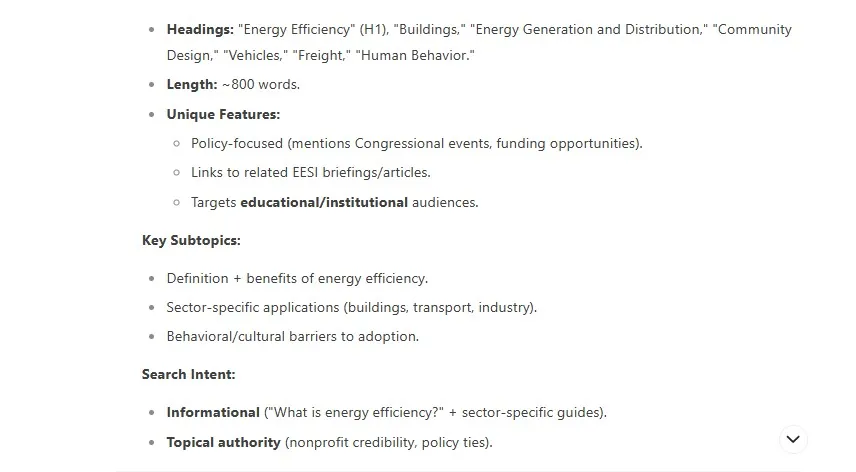
DeepSeek:
Produced a clean bullet-point breakdown of each article’s structure, main topics, and search intent. That alone gave me a good sense of what my article should cover.
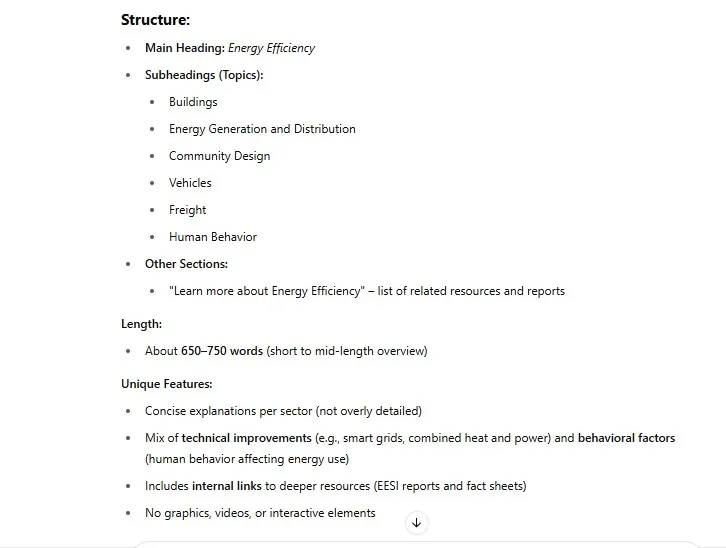
ChatGPT:
Gave me a similar but broader result.
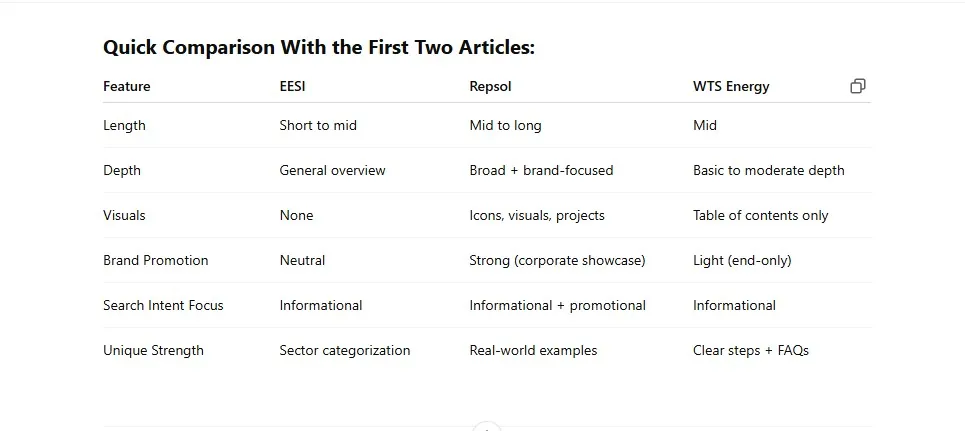
It also added a comparison table for quick reference.
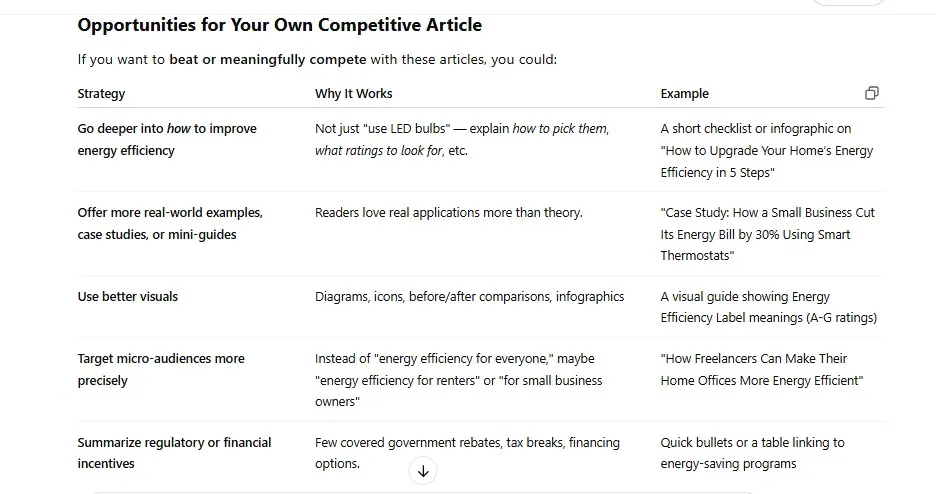
What really made a difference, however, was a follow-up question from ChatGPT. It asked if I wanted a summary comparing the three articles based on their patterns, strengths, and weaknesses. I accepted, and it delivered:
- A table, based on competitor gaps, outlining strategies for strengthening my article, reasons why those changes mattered, and examples of ways to apply them
- A four-step summary to guide my rewrite
I copied those into a file for easy reference for drafting.
B. 2 Ways AI Can Uncover Overlooked Angles
1. Spotting Missing Topics and Angles
Goal: Find content gaps fresh ideas to improve your draft.
Method:
I pasted my draft and a competitor’s article into both ChatGPT and DeepSeek. My first prompt instructed them not to analyze the articles yet, as I wanted to guide the process step-by-step.
The prompt was:
“I’m going to paste two articles. One from a competitor, the other my own draft. Then I’ll ask you a few questions. Just read the articles. Don’t respond until I ask.”
What happened:
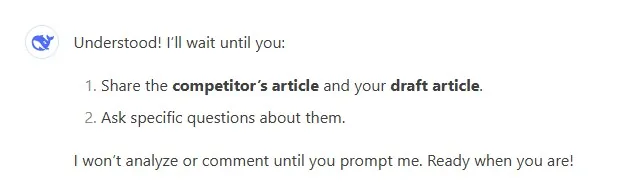
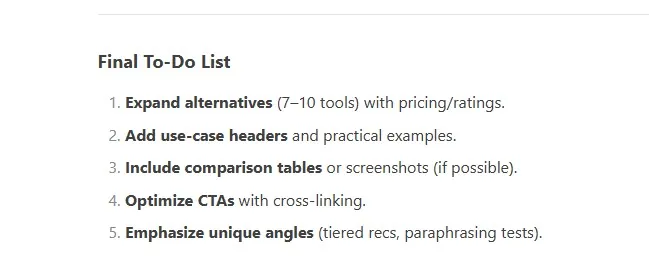
DeepSeek generated an analysis immediately, but the output was valuable. Its side-by-side breakdown of the two articles included:
- A comparison of structure and depth
- Identification of SEO and readability issues
- Suggestions for unique angles
- A review of CTAs with improvement ideas
- An actionable to-do list for implementation
ChatGPT
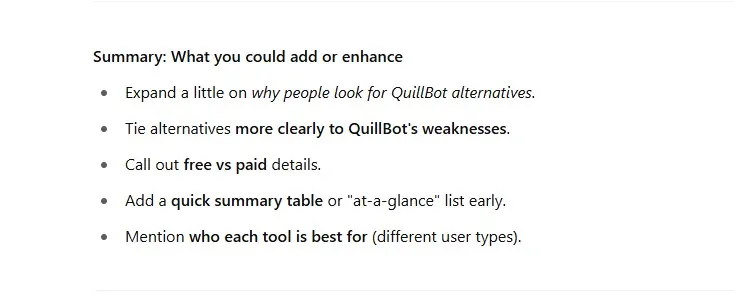
ChatGPT waited as instructed. Then I followed up with the Second Prompt:
“Based on this competitor article and the search intent for ‘QuillBot alternatives,’ what important points or angles are missing that I could include in my draft?”
Its response provided a clear comparison, highlighting the key weaknesses in my draft:
- A lack of specific, direct comparisons pitting alternative tools against QuillBot’s weaknesses.
- Missing elements that the competitor had nailed, like a summary table and a “best for” breakdown by audience.
It concluded with a bulleted list of new sections I could add to improve the article.
DeepSeek (again)
Next, I ran the same prompt through DeepSeek.
The response came in two clear parts:
a) What I missed
b) How to win
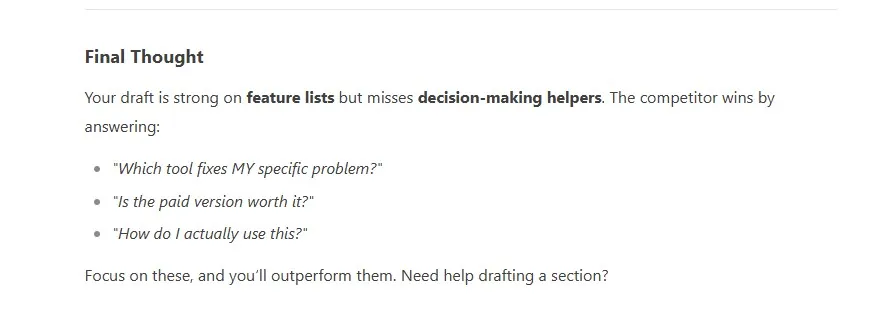
This analysis dug deeper. It highlighted valid blind spots, like my failure to state my criteria for choosing alternatives tools or show how the tools actually work.
It also uncovered angles my competitors had missed. One standout idea: test each tool with the same input and compare the results directly to QuillBot. I might not implement it, but it’s a smart approach.
It also raised concerns around AI detection and plagiarism—topics that appear in Google’s “People Also Ask” and that my competitor is already ranking for (as shown by Moz’s Keyword Gap tool).
Then came the core critique: it stated my draft wasn’t deep enough and that I wasn’t answering the right questions to help readers decide. It gave me three key questions to cover and declared:
“Focus on these, and you’ll outperform them.”
A bold claim. But I’m listening.
2. Tone Check
Goal: Bonus insight for polishing content beyond structure and keywords.
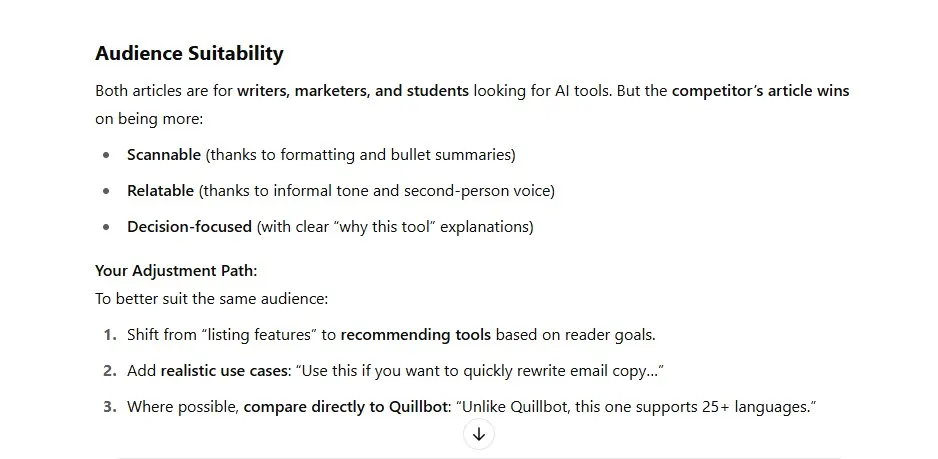
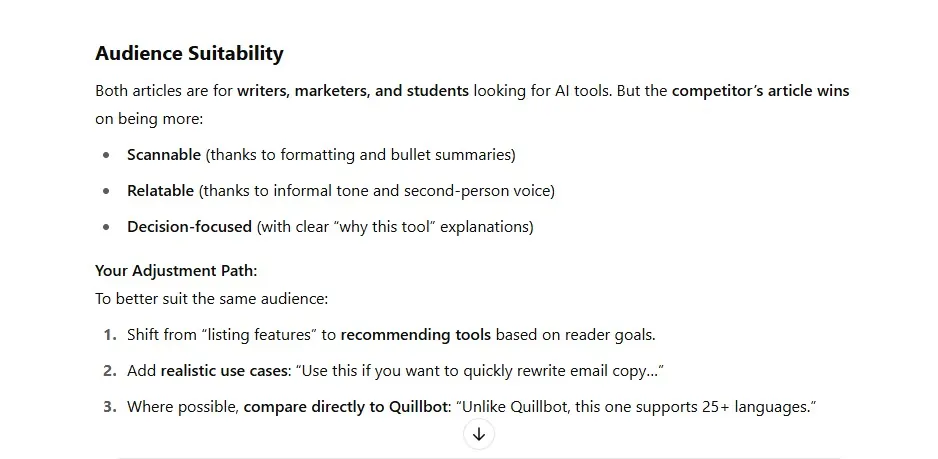
Prompt: “Compare the tone and style of these two articles. Which one is more clear, engaging, or suited to the audience, and how could I adjust mine?”
Result:
ChatGPT’s analysis was clear: my article sounded flat and technical. The competitor’s, however, was more conversational, scannable, and easier to read.
C. Finding Missing Keywords with ChatGPT
Goal: Spot keyword gaps.
Step 1:
I used ChatGPT to extract a list of keywords from a top-ranking article.
Prompt:
“Analyze this competitor’s article and extract the key topics, entities, and semantic keywords it covers. Focus on terms that are central to the subject.”
Step 2:
I provided ChatGPT with the list and my article, asking it to identify which terms were missing and how to add them.
Prompt:
“Here is my article and a list of keywords. First, identify which of these keywords are missing from my article. Then, for each missing keyword, suggest a specific and seamless way to incorporate it—whether by adding a new subsection, inserting a sentence in an existing paragraph, or replacing a vague phrase with a more specific one.”
Result:
ChatGPT first provided a list of specific keywords my article was missing. More importantly, it then gave me a practical, actionable plan. For example, for the keyword “AI detection score”: It suggested adding a bullet point in the features section: “…and includes an AI detection score to help ensure originality.”
Expert Tip (and proof this works):
I adapted this method from a process except experiment by Sam Oh at Ahrefs’. He demonstrated how a content refresh based on keyword gap analysis can dramatically improve rankings. Here’s a breakdown:
- Problem: His article was underperforming, ranking at position 7 for a target keyword.
- Action: He used Ahrefs’ “Also talk about” feature to extract a list of keywords and topics covered by the top 10 ranking pages. Then, he used ChatGPT to identify which of these keywords were missing from his article.
- He rewrote the article to cover those missing keywords and topics.
- Result: The refresh propelled the article to #1 in Google search results and secured the featured snippet.
If you’d like to watch the complete process, you can find it here.
Sharpen Your Drafts with Fast AI Analysis
While Chatbots won’t replace your SEO tools, they help you go beyond performance and visibility data, comparing the writing, narrative, and overall reading experience.
Use the prompts and process in this article as a starting point. Adapt them to your specific goals, and you’ll gain the insights needed to create truly valuable content for your readers—and ultimately, outperform your competitors.